Recovery Factor vs. Cumulative Permeability-Thickness: A Simulation Benchmark Method
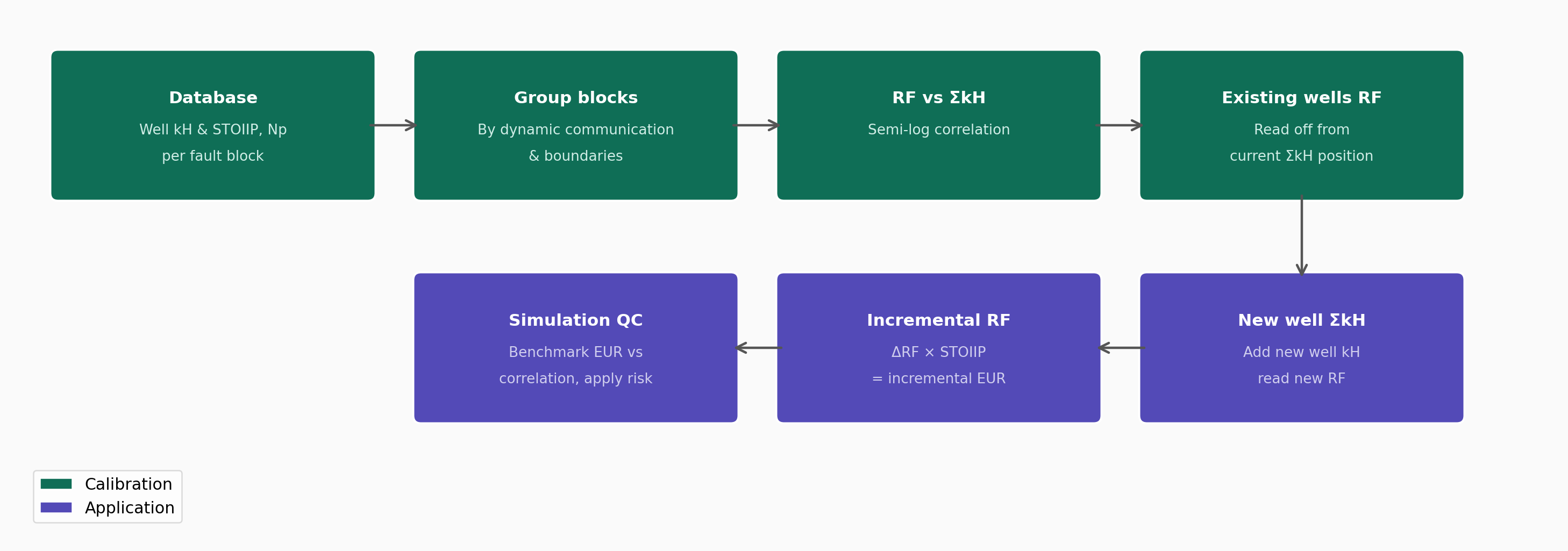
In mature field infill planning, dynamic simulation is the primary tool for estimating EUR per new well. Simulation results are frequently challenged by internal assurance teams, technical partners, or external reviewers in capital-intensive projects. For such scenarios, an independently derived correlation of Recovery Factor (RF) against cumulative permeability-thickness (ΣkH) provides a fast, transparent, and physics-grounded benchmark.
The underlying physics is straightforward: recovery factor increases log-linearly with ΣkH and reflects diminishing returns as drainage area expands. The method requires only performance and well completion data.
Field Illustration — Norne Field
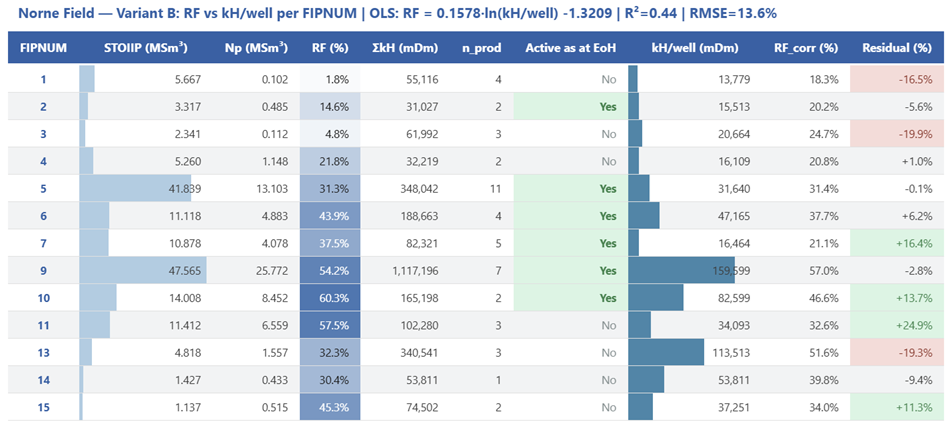
The Norne field (Norwegian Sea) was selected to illustrate the method. It is a mature field with production history and simulation models publicly available through the OPM project. The field comprises multiple fault blocks, each with distinct reservoir zones and drainage characteristics.
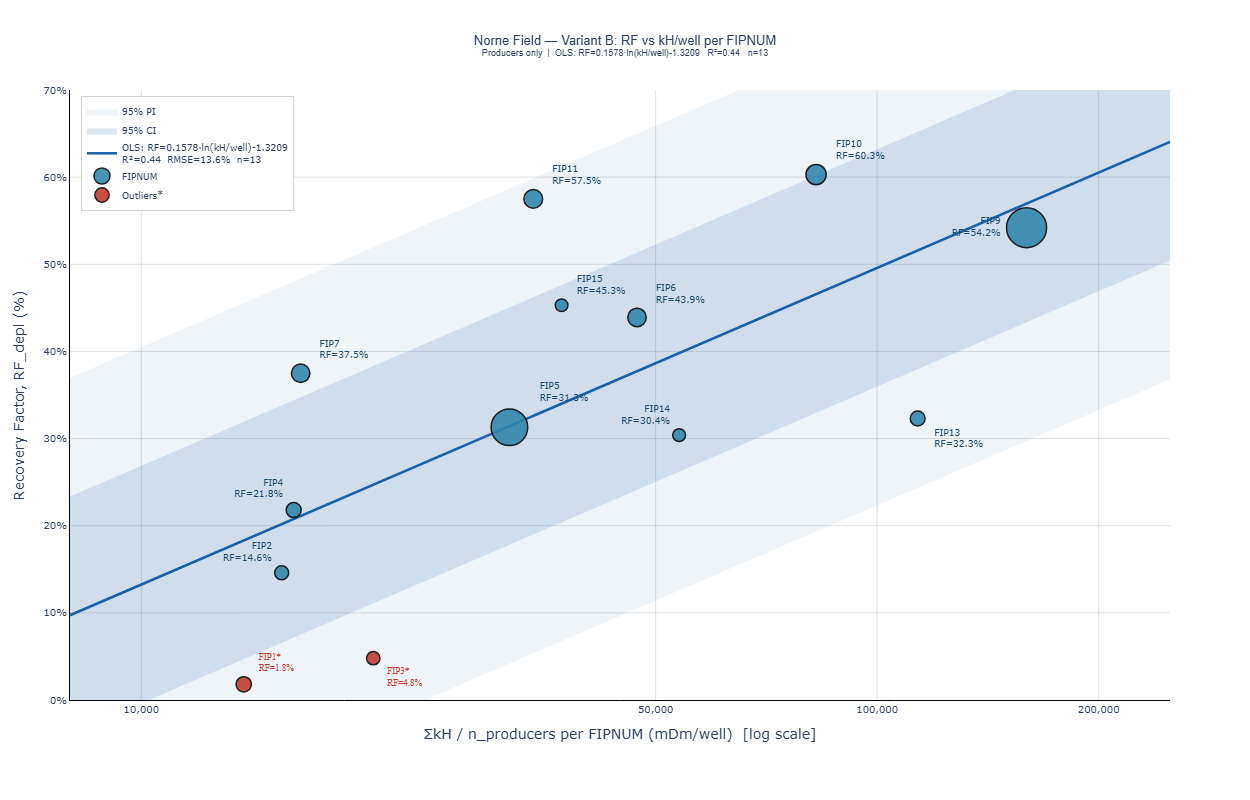
Well-level permeability-thickness (kH) was extracted from simulation deck COMPDAT records and summed per fault block. These were plotted against Recovery Factor (RF). A log-linear OLS fit was applied across all fault blocks.
Method Refinement — Dynamic Grouping
Some fault blocks showed low recovery due to being isolated or containing gas. Such blocks were filtered out from the calibration dataset as outliers. Separately, blocks with confirmed pressure communication and significant inter-regional fluid exchange were combined into groups. This approach yields a physically consistent correlation with R²=0.60.
Method Application — Norne FDP 2006
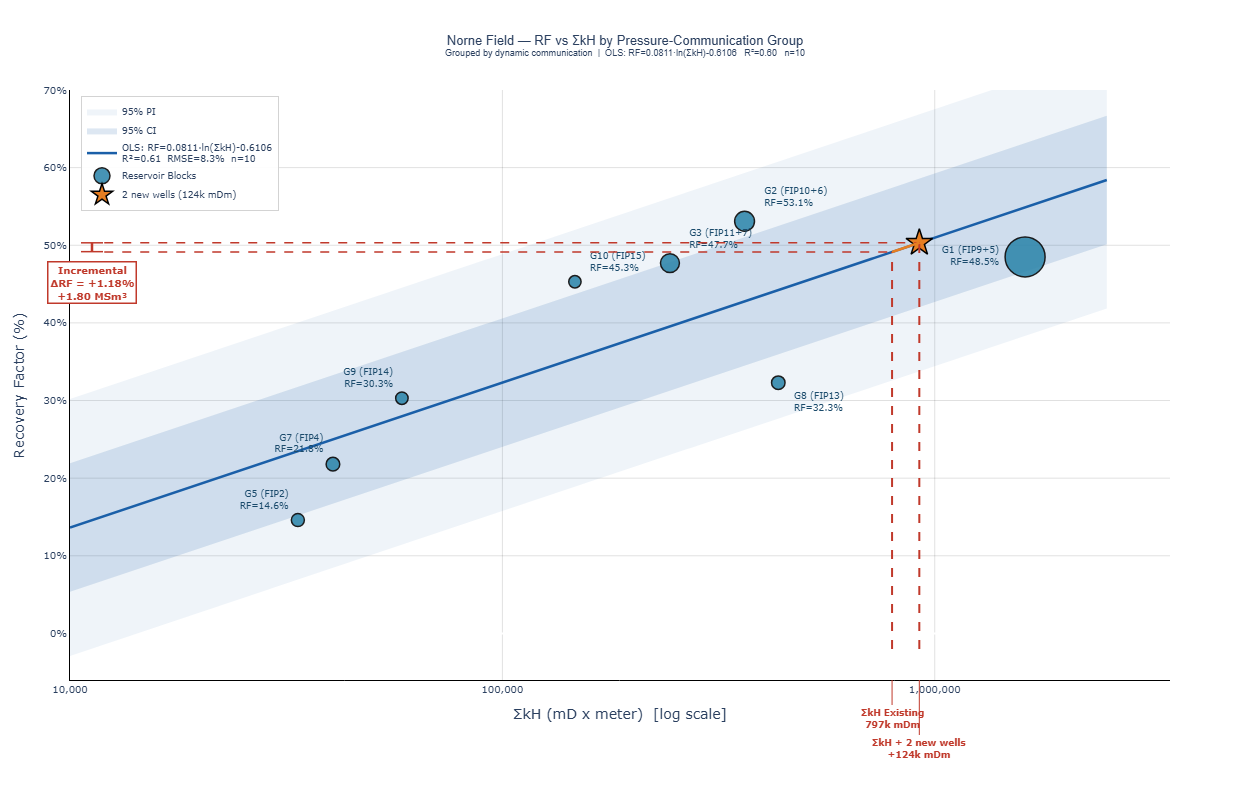
The publicly available Norne Field Development Plan (2006) was used to test the method in a realistic planning context. The plan proposes two new horizontal producers targeting the Upper Ile reservoir zone. Well locations are indicated in the FDP, but subsurface cross-sections do not provide sufficient resolution to derive exact completion kH directly. Instead, the average kH from existing Upper Ile horizontal wells was used as the analogue input.
Entering this value into the grouped correlation returns an incremental recovery of +1.18% RF readable directly off the y-axis — equivalent to 1.9 MSm³ of incremental oil recovery. This independent check surfaces any material difference between the dynamic model and the correlation. Where a gap exists, a risk factor can be transparently applied to the simulation production profile and documented for assurance review.
- A log-linear correlation of RF vs. ΣkH provides a fast, physics-based benchmark that is independent of simulation assumptions and straightforward to defend in assurance reviews.
- Applied to Norne, the method confirms a strong correlation across fault blocks and a statistically significant result that strengthens further when blocks are grouped by pressure communication.
- Tested against the Norne FDP 2006 infill programme, the correlation returns an incremental recovery consistent with the development plan — or, where a gap exists, enables transparent risking of the production forecast.
- The method is fast enough to run during a planning meeting and requires no specialist software beyond a spreadsheet or a few lines of Python.
Results from the Norne field should be considered for illustration purposes only. Subsurface public data is rather limited and Norne was used out of necessity to demonstrate the workflow in an open, reproducible context, not because Norne represents an ideal candidate. The method is best suited to fields with more pronounced faulting, where individual fault blocks exhibit greater variation in drainage efficiency and pressure isolation. In such settings, the contrast in ΣkH across blocks is larger, the physical basis for the log-linear correlation is more pronounced, and the calibration dataset is richer. Lightly faulted or homogeneous fields with limited block-to-block variability will generally yield a weaker correlation and should be approached with additional caution.